

Updated: Sep 8

Executive Summary
Equity markets advanced in August, with emerging markets and the tech-heavy Nasdaq Composite leading the way despite a challenging geopolitical backdrop.
The earnings release of Nvidia, considered a bellwether for the artificial intelligence (AI) trade, easily outpaced analyst estimates late in the month and helped lead markets higher.
Federal Reserve Chair Warsh struck a hawkish tone speaking after the Economic Policy Symposium in Jackson Hole, which led markets to increase the odds of an interest rate hike in September.
A surprise Treasury intervention in Treasury bond markets also captured headlines in August, bringing the federal government deficit into greater focus as we approach the mid-term elections in November.
Equity Markets Climbed in August
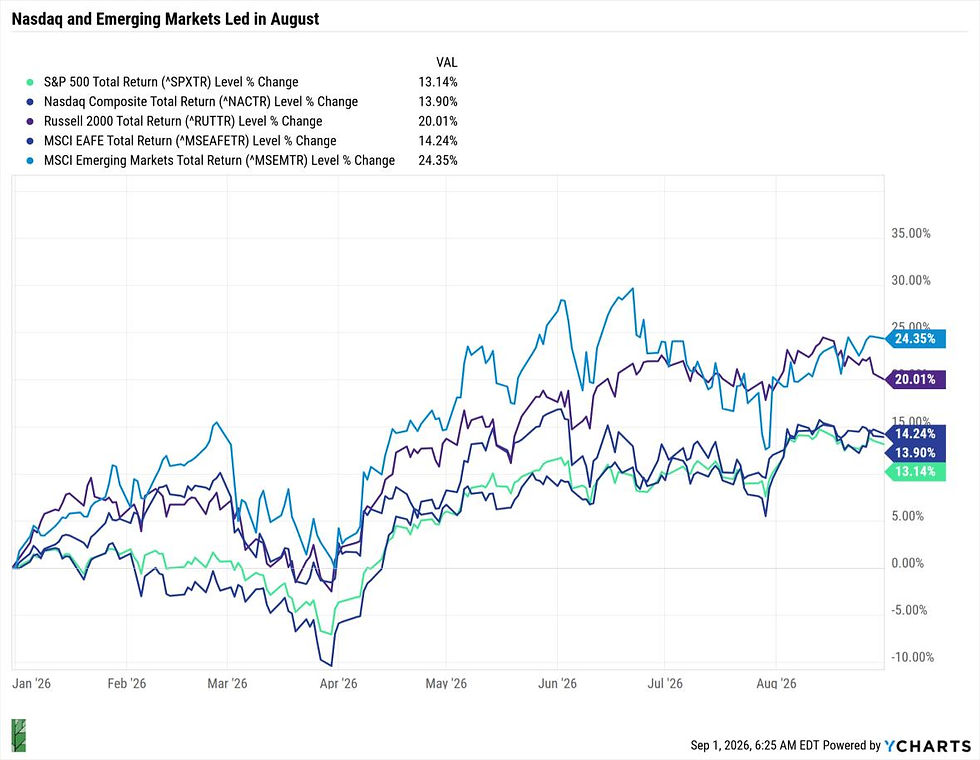
Equity markets rose in August despite a worsening geopolitical backdrop. The Nasdaq Composite (a tech-heavy index of US stocks) and MSCI Emerging Markets (EM) indexes led the way during the month, both advancing between 3-4%. The S&P 500 (proxy for US large-cap stocks), the Russell 2000 (a proxy for US small-cap stocks), and the MSCI EAFE (a proxy for developed international stocks) all posted more modest gains. The monthly advance pushed all five indexes higher year-to-date, with the MSCI EM and Russell 2000 indexes remaining in the lead.[1]
Nvidia’s earnings release in late August provided a spark for tech and AI-related stocks. The company reported revenue of over $96 billion for the quarter (Q2 of 2027 fiscal year) and projected $108 billion for the third quarter, beating analyst expectations. The company also forecast 70% sales growth in fiscal year 2028, an ambitious projection from the world’s most valuable company and a positive sign for the scale and durability of the AI capital spending cycle more broadly.[2]
The stock’s rise after earnings, complemented by strong monthly performance from tech mainstays Microsoft and Apple and memory/storage companies Micron and SanDisk, helped lift the Nasdaq during the month.[3] With the anticipated initial public offerings of Anthropic and OpenAI set to test markets in the coming months, the positive tech results provided some relief after a challenging prior two months.
Emerging markets performed well again in August. As with US markets, memory/storage stocks such as Samsung and SK Hynix rebounded during the month. In addition, precious metals rallied during August (more on that below), lifting shares of EM mining companies.[4]
Geopolitics, the Fed, and the US Treasury
Geopolitics played a role in markets yet again last month, as the US increased pressure on Iran with the announcement of “Economic D-Day,” targeting its aviation, shipping, technology, gold, and digital assets. The US also warned countries that trade with and support Iran, including China, Russia, India, and Turkey, with secondary sanctions if they do not cut economic ties.[5] The conflict with Iran turned kinetic shortly thereafter when the US bombed missile-launch facilities and Islamic Revolutionary Guard Corps sites, and Iran responded in kind with attacks on US bases in Jordan, Kuwait, and Bahrain and on merchant ships in the Strait of Hormuz.[6] [7]
Additionally, an impasse in trade negotiations between the US and Canada escalated into a trade war late in the month. The US announced tariffs on roughly $20 billion in Canadian imports when talks fell apart. Canada retaliated with tariffs of its own on more than 700 products made in the US (including steel, aluminum, dairy products, paper products, appliances, farm equipment, and vehicle components), with counter-tariffs scheduled to begin September 8. Ontario Premier Doug Ford also threatened to triple the price of exported potash, metals, and rare earth minerals.[8] To support affected citizens, Canada announced an aid package including loans and employment insurance changes for industries damaged by the trade conflict.[9]
Rising geopolitical tension on multiple fronts, all of which are potentially inflationary, lifted both gold (S&P GSCI Gold index below) and commodities (Bloomberg Commodity Index below), in August. The Bloomberg Commodity Index is now up more than 30% year-to-date, outpacing most stock and bond indexes so far this year. Interest rates have also moved higher, in part due to inflation concerns, leading to a challenging environment for bonds, with the Bloomberg US Aggregate Index slightly negative year-to-date.

The Kansas City Fed hosted its annual economic symposium in Jackson Hole, Wyoming, in late August. In his address, Chair Kevin Warsh signaled that the Fed would have “work to do” if they do not see progress on inflation soon and noted that the Fed has now missed its 2% inflation target for 65 consecutive months. The probability of a September rate increase jumped to 62% from 35% the previous day, after his hawkish message.[10]
In addition to announcing the economic pressure campaign against Iran, US Treasury Secretary Scott Bessent made headlines in August with the surprise announcement that the US Treasury would “at least double” the amount of long-dated (10- to 30-year) Treasury bond buybacks in an effort to provide liquidity to the bond market.[11]
However, the announcement received even more press when Stan Druckenmiller, famed hedge fund investor and mentor to both Bessent and Warsh, wrote an op-ed in the Wall Street Journal. In that piece, Druckenmiller criticized the action, writing, “This wasn’t liquidity management, it was price management — and a mistake far larger than $4 billion suggests.” One of Druckenmiller’s main contentions was that rising long-term interest rates are a signal from the bond market that the ballooning US deficit must be addressed, and that message is lost if interest rates are manipulated. He stated, “every basis point of artificial yield suppression is a subsidy to procrastination. Suppressed long rates sugarcoat the interest-cost projections, shrink the apparent urgency, and let incumbents assure voters the debt is someone else’s problem.” [12]
Articles from the Financial Times and others followed suggesting that the actions of the US Treasury to effectively lower long-term interest rates, which could spur economic activity such as home purchases, conflict with the Fed’s objective of reducing inflation.[13] In our opinion, the interplay between the Fed and the US Treasury will be worth watching.
The 2-year US Treasury yield ticked up slightly in August after the Jackson Hole symposium, while the 10-year and 30-year yields both remained relatively flat for the month. However, all three yields remain significantly above levels at the beginning of 2026, when markets were pricing in interest rate cuts before the Iran conflict broke out.

The Path Forward
Regardless of your opinion of Stan Druckenmiller’s criticism of US Treasury actions last month, his piece drew attention to the US federal deficit. As you can see below (first chart), the US budget deficit has been running at about 5% of gross domestic product (GDP) for the past few years (and OMB projections suggest it will stay in that range going forward). In fact, the last budget surplus occurred in the early 2000s.
Two decades of deficits have pushed federal debt held by the public to roughly the size of annual US GDP (second chart, below). The only other time we approached this level of debt-to-GDP was during World War II.[14]

While large deficits are not unique to the US, countries such as Japan, Italy, and Greece have larger relative debt-to-GDP, the trajectory of the projections by the CBO above is concerning.[15] The problem with running large deficits is that servicing that debt crowds out productive spending, such as upgrading aging infrastructure (roads, trains, airports, etc.) or improving educational outcomes for children, and reduces flexibility to respond to future economic downturns. Higher interest rates compound the problem, as borrowing and servicing the debt grow more expensive.
Unfortunately, there are no easy solutions to this problem. Raising taxes and cutting entitlement spending each impose costs on different groups, which makes either a difficult sell for politicians of either party. We expect the growing deficit to be one of myriad issues that voters will need to consider as we approach mid-term elections this November.
As always, we appreciate your continued trust and welcome the opportunity to speak with you in greater detail regarding your specific situation.
[1] Source: YCharts, August 31, 2026.
[2] Source: Financial Times, “Nvidia forecasts 70% sales growth fueled by relentless AI boom,” August 27, 2026. https://www.ft.com/content/72908915-5e4a-457c-8c3a-aee8917a664a?syn-25a6b1a6=1
[3] Source: YCharts, August 31, 2026.
[4] Source: YCharts, August 31, 2026.
[5] Source: Financial Times, “Scott Bessent fires warning shot at Iran’s economic partners,” August 25, 2026. https://www.ft.com/content/b7a62337-c0f8-41f2-b4d4-7afbe6d63af1?syn-25a6b1a6=1
[6] Source: YCharts/MT Newswires, “US Equity Indexes Fall Amid Gains in Crude Oil, Benchmark Treasury Yield as Iran War Hostilities Resurge,” August 31, 2026. https://finance.yahoo.com/markets/stocks/articles/us-equity-indexes-fall-amid-210357286.html
[7] Source: Bloomberg, “’We Are Stalled’: US-Iran Conflict Stuck With No End in Sight,” September 3, 2026. https://www.bloomberg.com/news/articles/2026-09-03/-we-are-stalled-us-iran-conflict-stuck-with-no-end-in-sight?srnd=homepage-americas
[8] Source: Financial Times, “’We got attacked’: Canadians unite in fury against Donald Trump’s latest tariff salvo.” August 26, 2026. https://www.ft.com/content/615a1b65-3949-4297-a87a-e0d23fbfcecf?syn-25a6b1a6=1#comments-anchor
[9] Source: Bloomberg, “Canada is Hitting Hundreds of US-Made Items with Tariffs,” August 28, 2026. https://www.bloomberg.com/news/articles/2026-08-25/canada-is-hitting-hundreds-of-us-made-items-with-tariffs-read-the-list
[10] Source: Financial Times, “Hawkish Kevin Warsh hints Fed will raise rates if inflation does not fall soon,” August 28, 2026. https://www.ft.com/content/d15851dc-9177-4bfe-9039-8d9994a2e4b3?syn-25a6b1a6=1
[11] Source: Financial Times, “US Treasury to boost long-term bond purchases in bid to steady market,” August 19, 2026. https://www.ft.com/content/777c9014-2f12-45cf-8224-6bbe808c62cb?syn-25a6b1a6=1
[12] Source: Financial Times, “Bessent gets Drucked,” August 25, 2026. https://www.ft.com/content/9d61ca14-6939-4efa-a6fe-0ec1b283d77a
[13] Source: Financial Times, “Scott Bessent’s bond intervention puts US Treasury on collision course with Fed,” August 26, 2026. https://www.ft.com/content/a50df99b-0621-44ea-a7c7-c9c685e2eba1?syn-25a6b1a6=1
[14] Source: Apollo, “The Daily Spark – Rates Will Stay Higher For Longer,” August 26, 2026. https://www.apollo.com/wealth/insights-news/insights/daily-spark/Rates-will-stay-higher-for-longer
[15] Source: International Monetary Fund, “IMF Datamapper 2026,” April 2026. https://www.imf.org/external/datamapper/GGXWDG_NGDP@WEO/OEMDC/ADVEC/WEOWORLD
Important Information
Past performance may not be representative of future results. All investments are subject to loss. Forecasts regarding the market or economy are subject to a wide range of possible outcomes. The views presented in this market update may prove to be inaccurate for a variety of factors. These views are as of the date listed above and are subject to change based on changes in fundamental economic or market-related data.
Content is provided by Investment Research Partners, LLC. All data and information reference herein are from sources believed to be reliable. Any opinions, news, research, analyses, prices, or other information contained in this research is provided as general market commentary, it does not constitute investment advice. IRP shall not in any way be liable for claims, and makes no expressed or implied representations or warranties as to the accuracy or completeness of the data and other information, or for statements or errors contained in or omissions from the obtained data and information referenced herein. The data and information are provided as of the date referenced, and such data and information are subject to change without notice.
IRP employs artificial intelligence using a number of platforms for the purpose of researching investments and comparing various investment platforms. IRP has evaluated the security of these AI platforms, and does not use any platform that uses client information to train its models or that maintains sensitive client information in its records. Further, human input is required by IRP policy to ensure accuracy of the information generated by AI, and any data aggregation or document summaries. The use of these platforms will be reviewed periodically to ensure confidentiality and accuracy as well as efficiency.
Certain third-party sources cited in this material may require a paid subscription or may otherwise be located behind a paywall. If you would like more information regarding any cited source, please contact IRP and we will provide additional details upon request. Please contact your Advisor in order to discuss your specific situation.

Click below to view our September 2026 Market Outlook video

